영어 교육에서 Reading(읽기)과 Listening(듣기)은 정보를 받아들이는 수용 기능(Receptive Skills)으로 분류됩니다. Unit 5에서는 학생들이 단순히 텍스트를 읽고 음성을 듣는 것을 넘어, ‘전략적’으로 의미를 파악하도록 교사가 어떻게 수업을 설계해야 하는지 배웠습니다. 핵심 내용을 3가지 단계로 요약합니다.
목차
1. TEFL Unit5 어휘 분석 및 사전 지도 (Selecting & Pre-teaching Vocabulary)
본문을 읽기 전, 학생들이 내용을 이해하는 데 걸림돌이 될 만한 핵심 어휘를 미리 가르치는 단계입니다.
- 어휘 분석 표 활용: 단어를 선정할 때는 단순 뜻뿐만 아니라 품사(Form), 맥락에 맞는 의미(Meaning), IPA 발음기호 및 음절 스트레스(Pronunciation)를 교사가 완벽히 분석해야 합니다. (CEFR 레벨에 맞춘 단어 등급 조정 필수!)
- 교사 언어 조정 (Language Grading): 새로운 단어를 설명할 때는 학생들이 이미 아는 쉬운 단어(B1 등)만 사용해야 합니다.
- CCQs (Concept Checking Questions): “이 단어 뜻 알겠니?”라고 묻는 대신, “게임이 addictive하면 쉽게 끌 수 있을까?”처럼 학생이 진짜 이해했는지 확인하는 ‘개념 확인 질문’이 핵심입니다.
2. 독해 단계별 문제 설계 (Reading Stages: Skimming vs. Intensive)
독해 수업은 학생들의 읽기 목적에 따라 단계를 나누어 진행됩니다.
- Stage 3: First Reading (Skimming & Scanning)
- 목적: 빠른 속도로 글의 전반적인 흐름을 파악하거나 특정 정보를 찾는 훈련.
- 활동: 3~5분의 짧은 시간 제한을 두고, 글 전체의 주제를 고르는 문제(Skim)나 구체적인 숫자·데이터를 찾는 문제(Scan)를 풉니다.
- Stage 4: Second Reading (Intensive Reading)
- 목적: 텍스트를 깊이 있게 분석하고 세부 인과관계를 파악하는 인텐시브 독해 훈련.
- 활동: 10~15분 동안 텍스트를 정독하며, 단순 단답형이 아닌 원인과 결과, 필자의 의도를 묻는 서술형 오픈 질문(Open-ended Questions)에 답하게 합니다.
3. 연계 말하기 활동 (Follow-on Speaking Stage)
읽기나 듣기가 끝난 후, 학습한 내용과 주제를 활용해 학생들이 직접 입을 열게 만드는 생산 기능(Productive Skills) 연계 단계입니다.
- 구어 유창성(Oral Fluency) 중심: 문법적인 제약에서 벗어나 학생들이 자유롭게 소통할 수 있는 기회를 제공합니다.
- 실생활 접목 활동: 지문의 주제(예: 일상 루틴)를 활용해 클래스 설문조사(Class Survey)를 하거나, 롤카드(Role Cards)를 활용한 짝 활동(Pair Interview)을 통해 자연스럽게 목표 문법(현재시제, 빈도부사 등)을 입으로 체득하게 만듭니다.
읽기 말하기 수업 설계하기 : 학습영상 바로가기
TEFL Unit5의 마지막으로는 학습을 잘 이행 하였는지 제공된 문서에 답을 한 후 업로드를 해야 합니다. 오늘은 학습 완료 과제를 다뤄볼께요.
총 3가지 주제로 잘 학습하고 숙지 하였는지 나누어져 있습니다.
- Assignment A – Part 1 (Lower Intermediate) B2레벨 대상 Pre-teaching Vocabulary 설계
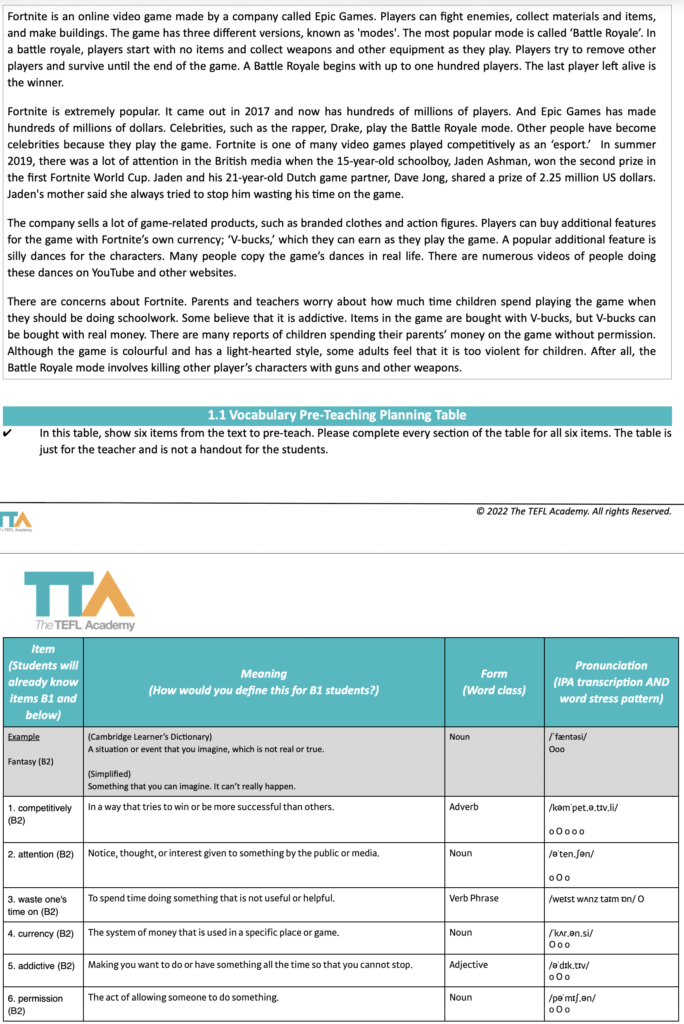
두 가지 문항 중 1번은 제시된 본문을 읽고 핵심 단어 6개를 뽑아 의미와 양식, 발음기호를 작성하는 것입니다. 두 번째는 본문 맞춤형 대화문을 작성하는 것입니다. 본문의 핵심 논쟁인 형용사와 명사를 대화문으로 구성하는 것이라 자유롭게 구성하면 됩니다.
두 번째 파트는 B2레벨 18~23세 성인/대학생을 대상으로한 Skimming& Scanning 설계하는 과정입니다. 모국어가 제2외국어 대상의 읽기 학습을 설계하는 것이라서 핵심을 잡아주는 것에 주 목적이 있다고 보면 됩니다. 글의 핵심을 빠르게 훑어보거나 특정 정보를 찾아내는 능력에 초점을 맞추어 문항구성을 하면 됩니다.
1. Stage 3 Task: Skimming & Scanning (First Reading)
- Stage Aim: To further develop skimming and scanning reading skills.
- Task Description: Students will be given a strict time limit (e.g., 3-4 minutes) to read Text 2 quickly. They will answer broad gist questions (skimming) and find specific numerical/factual data (scanning) without focusing on every single word.
Skimming Questions (Gist/Main Idea)
- What is the primary purpose of this article?
- Expected Answer: To explain the social structure and types of European honeybees, and to warn about the consequences of their declining population.
- Based on the text, are most bee species in the world social or solitary?
- Expected Answer: Most bee species are solitary (living alone or in smaller groups).
Scanning Questions (Specific Information)
- How many eggs can a queen bee lay in a single day?
- Expected Answer: Around 2,000 eggs.
- What percentage of a typical honeybee colony consists of drones?
- Expected Answer: Only about 15%.
- Out of the 100 crops that provide 90% of the human diet, how many rely on bees for pollination?
- Expected Answer: 70 crops.
2. Stage 4 Task: Intensive Reading (Second Reading)
- Stage Aim: To further develop gaining an in-depth understanding of a text through intensive reading.
- Task Description: Students will reread the text carefully and deeply. The questions require them to understand complex relationships, look for causes/effects, and analyze the specific text details.
Deep Comprehension & Detail Questions
- What biological factor directly determines whether a female larva will develop into a queen or a worker bee? Explain the difference.
- Expected Answer: Their diet determines the caste. Potential queens are fed only royal jelly throughout their larval stage, whereas worker bees are fed royal jelly only for the first few days and then switched to nectar and pollen.
- According to the text, what happens to the remaining drones when winter arrives, and what is the reason for this action?
- Expected Answer: They are thrown out of the colony. This is done to save resources for the hive during the winter.
- The text mentions “colony collapse.” What specifically happens during this phenomenon?
- Expected Answer: Large numbers of worker bees leave the nest and do not return.
Cause, Effect & Critical Thinking Questions
- Identify four major causes mentioned in the text that contribute to the worrying decrease in bee populations.
- Expected Answer: The use of pesticides, climate change, loss of habitat, and loss of plant biodiversity.
- Why does the author state that “a disaster for bees is a disaster for humans too”? Explain the ecological connection using details from the final paragraph.
- Expected Answer: Because bees pollinate 70 out of the 100 crops that make up 90% of our diet. Furthermore, they pollinate plants that animals rely on for food, and these plants produce the oxygen we breathe. Without bees, it could lead to a widespread ecological collapse.
마지막 파트는 A1 Level (Elementary) 25~56세 중급 성인 학습자 대상으로 한 Follow-on Speaking 연계 말하기 설계입니다. 이미 앞서 Unit4 단계에서 본문 이해와 핵심 문법/어휘(현재시제, 일상 루틴, 빈도부사) 학습이 끝났으므로, 이번 20분 동안은 학생들이 주도적으로 참여하여 구어 유창성(Oral Fluency)을 키울 수 있도록 자유롭고 소통 중심적인(freer communicative) 2가지 활동으로 구성했습니다.
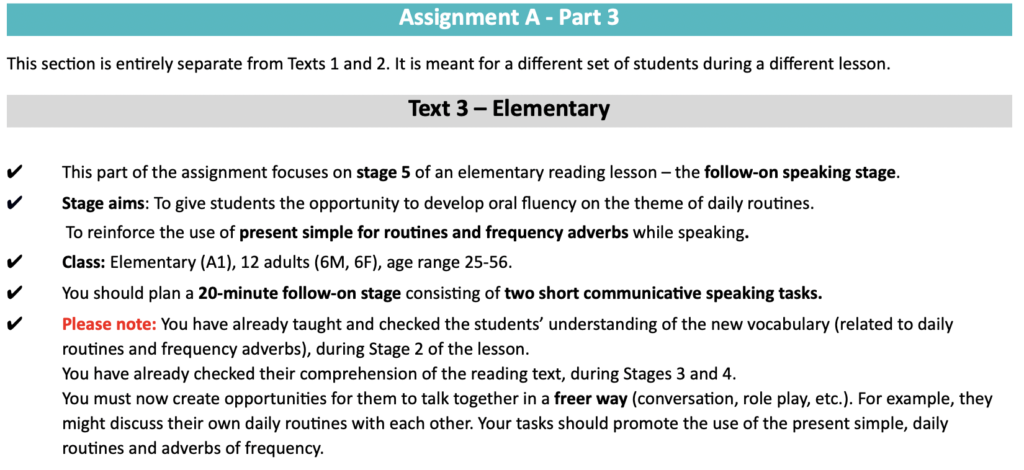
Stage 5: Follow-on Speaking Stage (Total: 20 minutes)
Task 1: “Find Someone with Bobbie’s Routine” Class Survey (10 minutes)
- Interaction: Student to Student (Whole class Interaction)
- Activity Aim: To provide a semi-controlled yet communicative opportunity for adult learners to practice asking questions in the present simple and using frequency adverbs, closely mirroring the routines described in the text (e.g., shopping habits, childcare, waking times).
Task Description & Instructions
- Set-up (2 mins): The teacher gives each student a grid containing prompts adapted from Bobbie’s life in the text.
- Teacher’s Instructions to Class:“Class, stand up and walk around the room. You need to find someone who does the same things as Bobbie or Moira. Ask your classmates questions using ‘Do you…?’ When someone says ‘Yes’, write their name and ask how often they do it. For example: ‘Do you wake up at 6.30 AM?’ -> ‘Yes, I do.’ -> ‘How often?’ -> ‘I usually wake up at 6.30.’ You have 5 minutes. Go!”
- Speaking Practice (5 mins): Students mingle around the classroom, talking and filling out their sheets.
- Feedback & Wrap-up (3 mins): The teacher asks 2-3 students to report their findings using the third person singular to practice adding ‘-s’ to verbs (e.g., “Min-ho always goes to the supermarket on Saturday morning, just like Moira.”).
Sample Student Survey Grid
| Find someone who… | Name | Frequency Adverb Used |
| …wakes up at half past six in the morning. | Maria | She usually wakes up at 6.30. |
| …takes a walk in the park. | John | He often walks in the park. |
| …goes shopping on Saturday morning. | Yuki | She always shops on Saturdays. |
| …gets a takeaway or goes out for a meal. | Ahmed | He occasionally gets a takeaway. |
Task 2: “Stay-at-Home vs. Working Life” Pair Interview (10 minutes)
- Interaction: Pair Work (Student A + Student B)
- Activity Aim: To give students the opportunity to develop oral fluency by contrasting their own routines. This directly links to the text’s theme where Bobbie is a stay-at-home dad and Moira is a working engineer.
Task Description & Instructions
- Set-up (1 min): Students are divided into pairs. One student reflects on their busy working/studying routine (like Moira), and the other reflects on their home/household routine (like Bobbie).
- Teacher’s Instructions to Class:“Now, work with your partner. Interview each other about your weekly life. Student A, tell your partner about your routine at home—cooking, cleaning, or looking after family. Student B, tell your partner about your working or studying routine outside. Use frequency adverbs like usually, often, always, and occasionally to describe your habits. You have 6 minutes.”
- Speaking Practice (6 mins): Pairs talk together. The adult learners (aged 25-56) can naturally share their real-life experiences as parents, homemakers, or professionals, ensuring high engagement.
- Student A (Home focus) sample: “I every day cook the evening meal except Friday. On weekends, I usually tidy the house.”
- Student B (Work focus) sample: “I always leave the house at 7.30 AM. I sometimes have a chat with my colleagues during lunch.”
- Feedback & Delayed Correction (3 mins): The teacher shares a few interesting points heard during the activity and does a quick error correction on the board, specifically targeting the correct word order of frequency adverbs (e.g., correcting “I every day cook” to “I cook every day” or “I always cook”).
💡 과제 제출용 코멘트 (Why this works for your assignment)
- Text Integration: 첫 번째 활동의 질문들이 지문 내용(6시 반 기상, 공원 산책, 토요일 마트 가기 등)과 직접 연계되어 수업의 통일성을 높입니다.
- Adult-Friendly Context: 성인 학습자들이 일상적으로 겪는 가사 노동(Home life)과 직장 생활(Working life)의 밸런스를 주제로 다루어, 유치하지 않고 몰입도 높은 대화를 이끌어낼 수 있습니다.
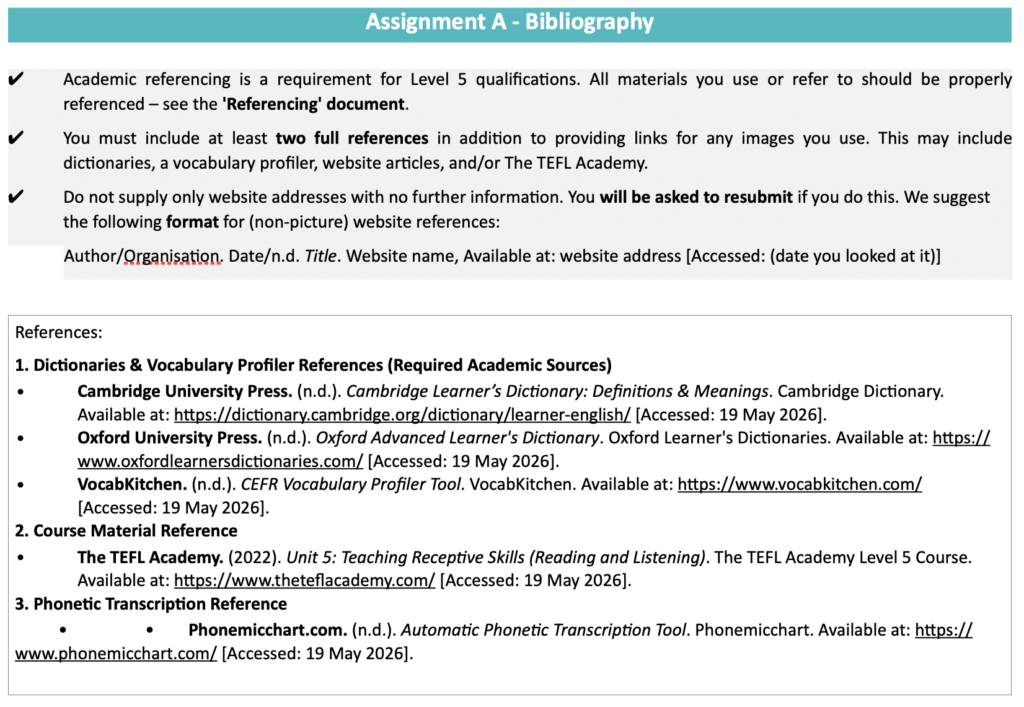
그리고 진짜 마지막으로 교수설계안의 가장 마지막에는 참고자료의 출처를 명시해야 합니다.